Autoimmune Support
You should never have to carry this alone.

My name is Rene. I am a counsellor. I have also lived with an autoimmune condition for several years.
For a long time I kept those two facts apart, because there is an assumption that the person holding the room should not be a person coming undone in parts of her life. But for a while, I was.
The early years were frightening in a subtle but dreadful way. Appointments. Tests. Being told things that did not add up, while my body kept attacking itself regardless of how sensible I was being about it.
Autoimmunity is lonely in a specific way. You look fine. You are told you look fine (or better). Meanwhile something inside your body is working against you and nobody can see it, so you end up carrying the evidence alone.
I am living well now.
Not cured. Well.
So I want to share what I have gathered along the way, the practical and the physiological and the emotional with people who are in the frightening part of their journey. I do not have a protocol to share. What I have is the fact of having been there, and a few things I know now that I wish I had known at the start.
Resources
-
Ang Poon Liat, The Wonders of Nutrition (2015).
Launched as part of a two-volume set alongside Roadmaps to Recovery, the book focuses on how modern processed foods and diet choices tie into chronic degenerative diseases. It explains how human genes and bodies respond to everyday food, promoting natural prevention, whole foods, and healthy lifestyle habits. Dr Ang Poon Liat has over 45 years of clinical paediatric and nutritional practice, and has also run specialised clinics focusing on autism and anti-ageing.
I read this early on, when I understood almost nothing about what I was putting in my body or why it might matter. It gave me a working grasp of how the body uses food, which I had somehow reached adulthood without. Everything else I read afterwards made more sense because I had that first. -
Most of the years I lost were spent being told nothing was wrong. That is a common experience with autoimmune conditions, and it is part of why the early stage is so isolating. What eventually helped me was not finding the right protocol. It was being properly assessed by different professionals who took the whole picture seriously.
I saw practitioners across both conventional and integrative medicine. What made the difference was stopping guessing and getting looked at properly, rather than any single approach.
I am a counsellor, not a doctor or a dietitian, so I am not going to tell you where to go or what to ask for. But these are the kinds of practitioner worth knowing exist:
A rheumatologist or endocrinologist, depending on your condition, usually by referral from a general practitioner.
An accredited dietitian, for anything to do with food.
Doctors practising integrative or functional medicine, if you want a broader workup than a standard consultation allows.
Traditional Chinese medicine practitioners, registered with the Traditional Chinese Medicine Practitioners Board. -
Journal Articles
Song, H., et al. (2018). Association of Stress-Related Disorders With Subsequent Autoimmune Disease. JAMA, 319(23), 2388–2400.
The largest study of its kind. Swedish researchers followed over 100,000 people diagnosed with stress-related conditions, including post-traumatic stress disorder and adjustment disorder, and compared them both to the general population and to their own siblings, over 32 years. Those with a stress-related diagnosis had a higher rate of autoimmune disease afterwards.
The sibling comparison is the part that is significant. Comparing someone to their own brother or sister accounts for shared genes and a shared childhood home, which is an element (or the lack thereof) that usually gets raised about this kind of research.
Like what the authors emphasised, it is an association, not a mechanism. It does not mean stress caused anyone's illness, and it certainly does not mean anyone brought this on themselves. What it says is that the nervous system and the immune system are not separate systems, and that a body held in prolonged stress is doing something measurable. That was useful to me, not as an explanation for why I got sick, but as a reason to stop treating rest and peace as optional.
_
Gutierrez Nunez, S., Peixoto Rabelo, S., Subotic, N., Caruso, J. W., & Knezevic, N. N. (2025). Chronic Stress and Autoimmunity: The Role of HPA Axis and Cortisol Dysregulation. International Journal of Molecular Sciences, 26(20), 9994.
If the Swedish study shows that stress and autoimmunity are linked, this one attempts to explain how. It is a review, so it gathers existing research rather than producing new findings, and it is written for researchers, so it is technical.
The core of it: cortisol is meant to keep inflammation in check. Under sustained stress, the receptors that cortisol acts on become less responsive. The hormone is still there, but the body stops listening to it. Inflammatory signalling rises, the cells that maintain tolerance drop in number and function, and the immune system becomes less able to tell self from not-self.
Reading this was enlightening for me. It gave a shape to something I had only understood emotionally, which is that a body kept in a state of alert for years is not neutral. It is doing something. This is also why I no longer treat rest as an indulgence I can defer until the work is finished.
The authors say directly that nobody knows why some people are vulnerable and others are not, and that whether these changes reverse once the stress lifts is still a question by itself.
_
Bower, J. E., & Kuhlman, K. R. (2023). Psychoneuroimmunology: An Introduction to Immune-to-Brain Communication and Its Implications for Clinical Psychology. Annual Review of Clinical Psychology, 19, 331–359.
An overview of how the immune system communicates with the brain. Most people assume the traffic runs one way, that stress affects the body. This paper spends most of its time on the other direction: what inflammation does to mood, to fatigue, to concentration, to sleep. That was the part I needed to read. Previously I had interpreted my own exhaustion and brain fog as a form of weakness and evidence that I am not trying hard enough. Not disciplined enough. Failing at something other people manage fine.
The paper offers a different reading of the same symptoms. Bower and Kuhlman describe inflammation acting on the brain and producing fatigue and impaired cognition directly. So the tiredness is not a report on your resilience. It is a physiological effect with a mechanism behind it.
It is written for psychologists rather than patients, so it is dense in places, but the first section on immune-to-brain signalling is readable and it is the section that changed how I understood my own symptoms._
Belkaid, Y., & Hand, T. W. (2014). Role of the Microbiota in Immunity and Inflammation. Cell, 157(1), 121–141.
The reference paper on why the gut matters to immunity at all. Written by researchers at the National Institutes of Health, and cited thousands of times since.
The idea that stayed with me is that this is not one system influencing another. The microbes in the gut help train the immune system in the first place, and the immune system in turn keeps those microbes in a workable arrangement. They developed alongside each other. When that arrangement is sustained, the body can respond to genuine threats while leaving harmless things alone.
_
Honda, K., & Littman, D. R. (2016). The microbiota in adaptive immune homeostasis and disease. Nature, 535(7610), 75–84.
More specific than the Belkaid paper, and it addresses the question I actually had, which was how something happening in the gut ends up affecting a thyroid or a joint.
The proposed answer involves immune cells that are shaped in the gut lining and then act elsewhere in the body. Two of the jobs those cells do are holding the gut barrier together and keeping the immune system from reacting to harmless things. When the balance of gut microbes shifts, both jobs are affected.
_
Irwin, M. R., Olmstead, R., & Carroll, J. E. (2016). Sleep Disturbance, Sleep Duration, and Inflammation: A Systematic Review and Meta-Analysis of Cohort Studies and Experimental Sleep Deprivation. Biological Psychiatry, 80(1), 40–52.
Seventy-two studies, more than fifty-thousand people. People with disturbed sleep or insomnia complaints had higher levels of two inflammatory markers, C-reactive protein and interleukin-6. Long sleep, over eight hours, showed the same. Short sleep showed higher C-reactive protein only.
When researchers deliberately deprived people of sleep in a laboratory, they did not find the same rise. Which tells us that the finding is about persistent disturbed sleep over time, not about one night of bad sleep.
_
Forsyth, C., Kouvari, M., D'Cunha, N. M., Georgousopoulou, E. N., Panagiotakos, D. B., Mellor, D. D., Kellett, J., & Naumovski, N. (2018). The effects of the Mediterranean diet on rheumatoid arthritis prevention and treatment: a systematic review of human prospective studies. Rheumatology International, 38(5), 737–747.
Four studies met the criteria. Two tested the diet directly, and both found less pain and better physical function in the people following the diet, measured on a pain scale and on the standard health assessment questionnaire used in rheumatoid arthritis. One found a reduction in the twenty-eight joint disease activity score, which is the clinical measure rheumatologists use to judge how active the disease is. The authors concluded that the pattern reduces pain and improves function in people already living with the condition.
The eating pattern being studied is not a protocol and there is no elimination phase. It is the traditional pattern of countries around the Mediterranean: vegetables, fruit, legumes, whole grains, nuts, olive oil as the main fat, fish and seafood regularly, poultry and dairy in moderate amounts, red meat rarely, and very little in the way of processed food or added sugar. The individual trials each have specified their own version of it.
What struck me was how the outcome that moved most reliably was pain and function. How people felt, and what they could do. For anyone living with autoimmunity, that is the outcome that will directly improve the quality of your life.
_
Support Group
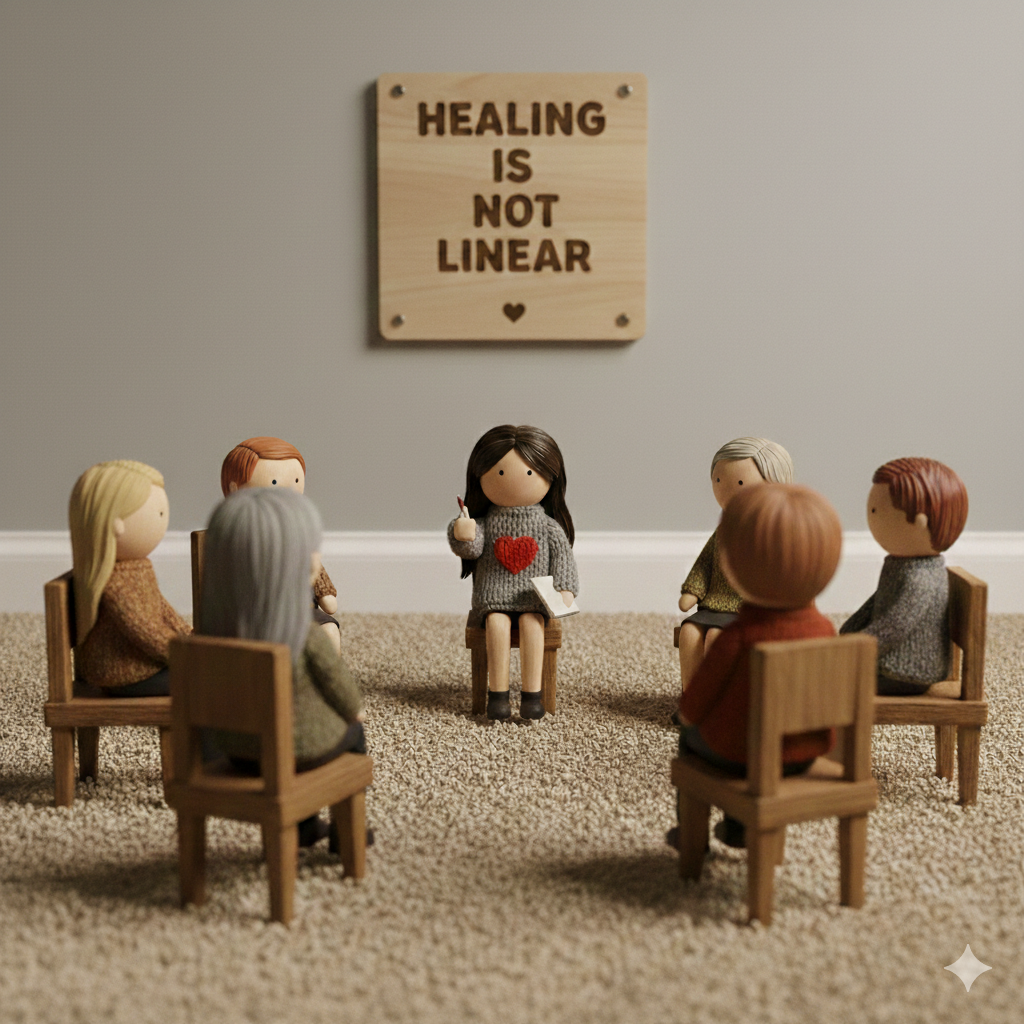
Most people with autoimmune conditions spend a lot of energy managing how they appear to others — functioning, explaining, minimising. This is a place to put that down for a while. To be with people who understand without needing it spelled out. Once in a while, we gather online for something simple but rare — genuine company in something that can feel very lonely.
❋ A Space That Gets ItNo justifying why you're struggling with something that doesn't show on the outside. This group is for people who know exactly how exhausting it is to look fine while your body is fighting itself — and who are tired of feeling alone in that. Each session creates space for you to share what's present — the hard days, the grief, the frustration, the small wins.
❋ Learning to Listen to Your BodyWe weave in gentle psychoeducation — the relationship between stress and autoimmunity, what chronic illness does to the nervous system, why your body responds the way it does. Living with an autoimmune condition means learning a different relationship with your body — one that's less about pushing through and more about understanding what it needs. We explore that together, practically and without pressure.
❋ Navigating the InvalidationOne of the hardest parts of invisible illness is the people around you who don't quite get it. Who think you should be over it by now. Who don't understand why you can't just push through. This group holds space for that particular kind of loneliness — and helps you find ways to cope with it that don't require anyone else to understand first.
❋ Grieving the Loss of HealthThere's a particular grief (and shame) that comes with chronic illness and autoimmunity that rarely gets named — the loss of the body you thought you had, the life you imagined, the ease that other people move through the world with that you have to work so much harder for. This group holds space for feeling the grief. Not to rush past it or reframe it into something positive. Just to let it be real for a while, with people who understand exactly what you mean.
Due to lack of participants, the autoimmune support group is on hiatus till enough interested parties have reached out. Interim, you may want to check out some of the articles written for autoimmunity here after registering your interest via the button below.
Upcoming Session
Details:Platform: Google Meet - URL will be sent via email
Duration: 60 minutes
Before You Join

A Space Built on Trust
Everything shared within the group stays within the group. What you bring here is held with care — by the facilitator and by every person in the room. That's the foundation everything else is built on.

Who This Is For
This group is specifically for people living with autoimmune conditions — navigating the daily reality of it firsthand. It isn't designed for caregivers or general chronic illness support. That specificity is intentional — because there's something particular about the autoimmune experience that deserves its own space.

The Facilitator
The group is facilitated by Rene Tan, a licensed counsellor specialising in attachment wounds, somatic therapy, and the emotional weight of autoimmunity. Rene lives with an autoimmune condition herself — her input comes from lived experience, not just clinical training.

You Don't Have to Commit
There's no obligation to show up every month. Come as and when you need, when life allows, when you're having a hard stretch, when you just need to be around people who get it. This group will be here.

You Don't Have to Speak
There's no pressure to share. You're welcome to simply listen, be present, and take what's useful. Some months that might be enough. That's completely okay.

What This Group Is Not
This is not a medical advice group and it is not therapy. Nothing shared here should replace your medical care or therapeutic support. It is a community space for connection, understanding, and company that makes hard things a little more bearable.


Attendance
Life with autoimmunity is unpredictable and we understand that completely. If something comes up, just let us know by email as soon as you can. Because spaces are set at 10 per session, we ask that those who are unable to attend three or more consecutive sessions kindly step back to allow others on the waitlist a chance to join. You're always welcome to sign up again for a future session.
*Please note that we will require your device’s camera to be on for the session (a face mask can be worn if you are uncomfortable with sharing your full face. This is to allow our participants a sense of safety.
Each session requires its own registration.